gms-intelligence-plugin




A Claude Code plugin that encodes a metal-roofing manufacturer’s domain knowledge as 7 eval-scored skills. Built as a real-world case study for Greenfield Metal Sales — also serves as a reusable template for building domain-expert Claude Code plugins in other verticals.
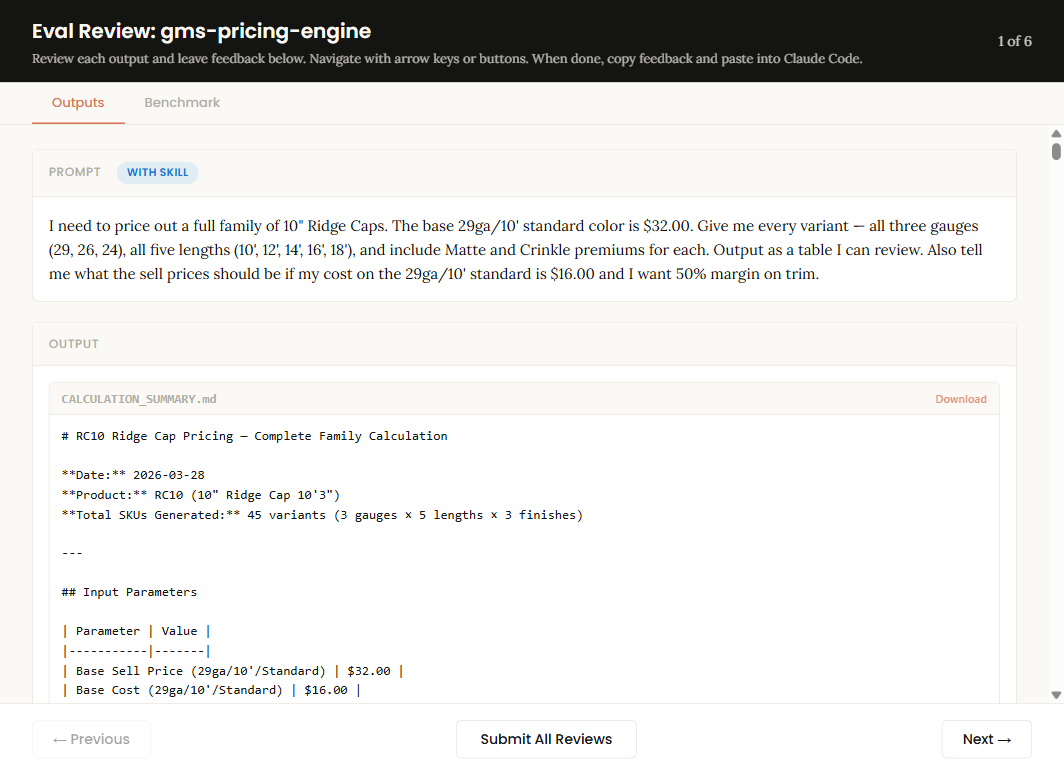
↑ A live eval review page. Click through for the full Sonnet-executor / Opus-grader breakdown of every prompt, every assertion, for all 7 skills.
What this is
Most “put Claude in a business” experiments end up as a RAG pipeline indexing random documentation. This plugin takes the opposite approach: structured, progressive-disclosure skills where each skill encodes one domain (pricing formulas, SKU structure, material sourcing, color catalogs, production workflow, supplier intelligence, inventory health) in markdown + Python.
When Claude sees a user query, only the relevant skill loads. A pricing question loads pricing-engine (~13K words); it does not load the supplier catalog or the color system. The load graph is explicit and readable.
Why that matters for recruiters looking at this repo:
- 7 working skills — not slideware. Each has a
SKILL.md, eval set, references (where relevant), and for the two most important skills, actual Python validators. - Eval-driven development — every skill was evaluated with a “with-skill executor” (Sonnet) graded by Opus against concrete assertions. Eval review HTMLs ship in
/evals/. - Zero training data required — this is not fine-tuning. The skills are plain markdown that any Claude Code user can install and run today.
- Real Python, not pseudo-code —
skills/gms-pricing-engine/scripts/shipscalculate_quote.py(24KB),margin_analyzer.py(22KB),validate_pricing.py(22KB).skills/gms-sku-decoder/scripts/shipssku_decoder.py(34KB) andsku_encoder.py(19KB).
The 7 skills
| Skill | What it encodes | Assets |
|---|---|---|
| gms-pricing-engine | Sell-price formula (base × gauge × length × finish), gauge/length/finish multipliers, margin targets per product category, what-if analysis |
SKILL.md + 5 reference docs (coil-pricing, color-codes, margin-tables, panel-specs, trim-profiles) + 3 Python scripts + evals |
| gms-sku-decoder | 91K+ product-ID catalog, family/gauge/color/length parsing, pattern A vs B material sourcing, reverse encoding (description → PID) | SKILL.md + 2 reference docs (color-to-code, family-registry) + 2 Python scripts + evals |
| gms-material-estimator | Panel/trim quantities from building dimensions, waste factors, stretchout math | SKILL.md + references + evals |
| gms-color-authority | 165+ colors across SMP (USS supplier) and Kynar/PVDF (CMG supplier) paint systems, contractor aliases, premium-finish markup logic | SKILL.md + evals |
| gms-production-nav | Assembly relationships, labor operations, manufacturing feasibility, coil → product traceability | SKILL.md + evals |
| gms-supplier-intel | Supplier routing (USS vs CMG), lead times, reorder points, coil specs, PO workflow | SKILL.md + evals |
| gms-inventory-health | Stock level modeling, velocity analysis, dead stock detection, reorder recommendations | SKILL.md + evals |
Commands
The plugin also exposes 3 slash commands that invoke the most common workflows:
/quote <description>— quick-quote a product with full cost breakdown (pricing-engine)/decode <PID>— decode a product SKU into human-readable components (sku-decoder)/color <name-or-code>— look up any color by name, code, or contractor alias (color-authority)
Eval methodology
Every skill was evaluated by spinning up two Claude instances:
- Executor (
claude-sonnet-4-5) — given the user prompt + the skill, produces an answer. - Grader (
claude-opus-4-6) — checks the answer against a hand-written assertion set in the skill’sevals/evals.json.
This catches regressions that human eyeballing misses. When I tightened the gauge multiplier from +20%-per-step to an exact table, the eval grader caught three places in the skill where the old formula still appeared in reference docs — I’d never have found those by reading.
The full eval-review HTMLs ship in /evals/ and render live via GitHub Pages:
- gms-pricing-engine — 30/36 passed (83%)
- gms-sku-decoder
- gms-material-estimator
- gms-color-authority
- gms-production-nav
- gms-supplier-intel
- gms-inventory-health
Each report shows every prompt, the with-skill output, the baseline (no-skill) output, and the assertion-by-assertion grading.
One concrete number worth knowing: the pricing-engine eval (3 evals, 36 total assertions) passes 30/36 = 83% — the 6 misses are edge cases around Pattern B material pricing that I’ve documented as known-limitations in the skill’s common-mistakes section.
Install
# from a cloned copy of this repo
claude plugin install ./
Or via the Claude Code marketplace flow (when published):
claude plugin marketplace add mattamundson/gms-intelligence-plugin
claude plugin install gms-intelligence
Skills live under ~/.claude/plugins/gms-intelligence/skills/ after install. Delete to uninstall.
Repository layout
.claude-plugin/
  plugin.json              # manifest consumed by `claude plugin install`
skills/
  gms-pricing-engine/      # SKILL.md + references/ + scripts/ + evals/
  gms-sku-decoder/
  gms-material-estimator/
  gms-color-authority/
  gms-production-nav/
  gms-supplier-intel/
  gms-inventory-health/
commands/
  quote.md                 # /quote — price a product
  decode.md                # /decode — parse a SKU
  color.md                 # /color  — look up a color
evals/
  *-eval-review.html       # eval-grader output per skill
docs/
  CASE-STUDY.md            # project context, methodology, and scope notes
  INSTALL.md               # detailed install / troubleshooting
Why I built it this way (pattern to steal)
If you’re building a Claude Code plugin for your business, the pattern that worked here:
- One skill per domain, not one skill per task. “Pricing” is a domain. “Generate a quote” is a task. The domain skill answers 100 task-shaped questions; a task skill answers 1.
- Triggers on intent, not keywords. The
descriptionfield in each skill’s frontmatter is how Claude decides whether to load it. Write it as “when the user asks X, Y, or Z, load me” — not as a keyword list. - References as separate files, not inline. Long reference tables (color codes, panel specs, margin tables) live in
references/*.mdand load lazily. The mainSKILL.mdstays scannable. - Evals from day one. The moment a skill has its first assertion, it’s testable. You can refactor the skill without breaking behavior.
- Safety rails in the SKILL.md itself. The pricing skill’s first section is literally “NEVER auto-execute pricing changes. Always preview, show before/after, require explicit CONFIRM.” Claude reads and obeys this exactly like any other instruction.
Scope note
This repo ships 7 of the 11 skills from the production system. The other 4 (competitive battlecard, sales outreach, customer intelligence, and an internal dev-assistant skill) aren’t in the public repo — see docs/CASE-STUDY.md for why and what they did.
License
MIT — see LICENSE.
Author
Matt Amundson. Built in early 2026 while Greenfield Metal Sales was standing up its AI operations center.